The Bradshaw Scale
Printed From: Nasgaweb
Category: Nasgaweb Forums
Forum Name: Training
Forum Discription: This forum is for discussion about training for the Scottish Heavy Events.
URL: http://www.nasgaweb.com/forum/forum_posts.asp?TID=2432
Printed Date: 3/26/26 at 9:51pm
Software Version: Web Wiz Forums 10.11 - http://www.webwizforums.com
Topic: The Bradshaw Scale
Posted By: Edward
Subject: The Bradshaw Scale
Date Posted: 3/31/06 at 10:54am
|
This should be a simple one and probably gets repeated at least once a year. Treat me like the novice I am, could someone explain the Bradshaw Scale for me? ------------- Ed |
Replies:
Posted By: Borges
Date Posted: 3/31/06 at 10:59am
|
This place needs a FAQ ------------- Cheers, Carlos "Live free or die" |
Posted By: jeffloosle
Date Posted: 3/31/06 at 11:19am
|
Hope this is still accurate:
The Caber The caber is done a little bit differently. Each caber is assigned a value. First the "Taper Factor" must be calculated. Take the distance from the large end to the center of gravity, call this A. Take the distance from the small end to the center of gravity, call this B. The taper factor is then A/B. This gives an idea of the taper of the caber. To calculate the value of the caber, multiply the length in feet of the caber times the weight in pounds times the Taper Factor times 0.55. This is the value an athlete gets if he/she turns the caber at 12:00. For anything less than this, 0.6 points/minute is subtracted. If the athlete does not turn the caber, but receives a score in degrees, 3 hours (or 108 points) is removed from the score, and this new number is now multiplied by (score in degrees)/100. Example: Let's say we have a caber that is 20 feet long, 110 pounds, and the center of gravity is 8 feet from the large end.
|
Posted By: Edward
Date Posted: 3/31/06 at 11:28am
|
That seems to settle it. Thanks. ------------- Ed |
Posted By: Wayne Hill
Date Posted: 3/31/06 at 12:33pm
|
Right: now, with all that said, I have my doubts that the formula really rates the difficulty of turning a given caber. For example, the main caber we used at MWC last year (my #4) rates 790 on the Bradshaw scale, a rating I thought should be manageable by most of the under-50's (based on my experience with similar-rating natural cabers). At MWC, only a minority of the 40-44 year class turned it (8 of 17), and only 2 of 10 of the 45-49 year class*. This stick is relatively untapered (its taper factor is all of 0.88), and long (19'2") for its relatively light weight (85 lbs). I've been toying with an analysis that should demonstrate whether or not the rating really reflects the difficulty of turning a caber, but it's very time-consuming and I haven't really gotten that far with it. -Wayne ________________________ * Funny story: one of the 45-49 year class athletes took one look at it and said it was too light, and would lead to a shoot-out. Bill Crawford said, "Well, if it turns out to be too easy a caber, we'll call it a qualifier and move on to a tougher stick." ------------- "We may be small, but we're slow." - MIT Rugby |
Posted By: AncientOne
Date Posted: 3/31/06 at 1:51pm
|
Carlos- That's a great idea! FAQ page would answer many of the common questions. And the good answers like Jeff's above coud be copied and pasted right to it without much trouble. Now, ... what did you say about the County Detox in LasVegas? -AncientOne ------------- Winners are remarkably adept at figuring out what's required to win. |
Posted By: Tim
Date Posted: 3/31/06 at 4:52pm
|
I've thrown many a caber in my time and I've found that I ALWAYS have trouble with the longer cabers. I can turn a 15' 150 lb caber but I have the damndest time with a 20' 90 lb stick. I've not done the calculations on these so I don't know what they would score on the scale. It has always seemed to me that there are more forces that need to be taken into consideration to score a caber. Physics was never my best subject (so why the hell am I thinking of math and physics on a Friday night- man I need a life), but wouldn't the distance through an arc come into play with longer cabers? Which variables are easiest to change- vertical thrust (strength) or horizontal velocity (speed)? Consistency of the ground also comes into play- mud, sand, hard earth. OK, these can't be calculated into a caber. These are just a few questions that come to mind when thinking of cabers and how the hell am I gonna turn them.
------------- "Remember, you don't take respect, you can only give it." Myles Wetzel-Forum post 10/2/07 Rock the House |
Posted By: Borges
Date Posted: 4/01/06 at 9:22am
|
Hey, the coffee sucks but I swear they make the fluffiest pancakes in Nevada. ------------- Cheers, Carlos "Live free or die" |
 AncientOne wrote:
Posted By: wallyworld
Date Posted: 4/04/06 at 9:04pm
I've been wishing two things; that someone out there would perfect that formula (I read a lot of bio's from athletes who've been to college), and that NASGA would use it when ranking athletes (good caber tossers get the short end of the stick)! We use Greg's formula at Enumclaw but we also keep track of how well each caber was turned last year and use that in the mix. ------------- "TRY NOT. DO OR DO NOT. THERE IS NO 'TRY'." Yoda |
Posted By: kspell
Date Posted: 4/05/06 at 3:35am
|
Wayne: You say the same thing everytime the issue comes up. Can we agree that this is probably the best system out there now? I know that the RMSA would look at any modifications to the formula or an entirley new formula. By the way, the RMSA most likely would use a caber that scores 790 as the main caber (after qualifier/before the "big stick") for the "A" class. or as a qualifier for the Pros. The thing that might be throwing off your comparisons is if your throwing a lot of hard wood cabers vs. lodge pole or ponderosa pine. The typical athlete can turn a longer and heavy hard wood stick due to the taper. ------------- Cheers! Kirk |
Posted By: Wayne Hill
Date Posted: 4/05/06 at 8:12am
|
Kirk, I certainly don't mean to denigrate the Bradshaw scale, since it's a serious attempt at doing something that I think is very worthwhile. It should certainly continue to be used until something better comes along. From my preliminary efforts, it doesn't look easy to come up with a better rating scale. What's throwing me off is the fact that my 790 caber seems to be a heck of a lot harder to turn than other cabers of similar or higher ratings. -Wayne ------------- "We may be small, but we're slow." - MIT Rugby |
Posted By: kspell
Date Posted: 4/05/06 at 8:40am
|
I would love a chance to toss the 790 of yours, sounds like a real biotch. ------------- Cheers! Kirk |
Posted By: Eclipse
Date Posted: 4/05/06 at 10:16am
|
Any current or potential formulas will have flaws based on the bias of the creator. In addition, in order to consider the variables, the complexity would become challenging for non-math people. In the Bradshaw, the taper is the key factor with height and weight being "equal" in their consideration. However, with a balanced caber (centerpoint is center of gravity) a 30ft 100lb caber is of equal value as a 10ft 300lb caber. While I am not a seasoned caber turner, I would argue the challenge level of a caber is not linear. Tim does address a good point. At what height, weight, or other consideration does a caber become more challenging to turn? Consider height alone, is a 24ft caber more challenging than an 22ft, a 22ft more challenging than an 20ft, a 20ft more challenging than an 18ft? ------------- "Somewhere in Russia, a little girl is warming up with your max." - Anonymous "Do not demand what you can not take by force." |
Posted By: Edward
Date Posted: 4/05/06 at 10:47am
|
The answer is longer is much more difficult. I consistently have more of a challenge with cabers over 17' than I do with sticks under 17'. I still choke in competition either way, but longer is harder. ------------- Ed |
Posted By: Eclipse
Date Posted: 4/05/06 at 11:04am
|
I agree Ed, and you have illustrated my question well with your 17' answer. Does the challenge become exponential beyond x ft? Unlikely, but it does need to be considered with greater emphasis than a shorter caber. ------------- "Somewhere in Russia, a little girl is warming up with your max." - Anonymous "Do not demand what you can not take by force." |
Posted By: McSanta
Date Posted: 4/05/06 at 11:45am
|
How about doubling up the length past 15 feet. L1 = length up to 15' (is =15 if the caber is greater than 15 feet) That would move Waynes Caber from 788 to 960
------------- Mark McVey "The work of science is to substitute facts for appearances and demonstrations for impressions." -John Ruskin |
Posted By: McSanta
Date Posted: 4/05/06 at 11:52am
|
Only thing needed is a bunch of data points that have Length, Weight, Taper, # who tried to turn it, # who turned it, class I think then a person could use the data to modify the breakpoint (15 feet) and the multiple (2) to get perhaps a better formula. This formula is not based on some physics calculation -- It is a simple way of taking into account that longer cabers are harder to turn. Given that I pulled 2 and 15 out of my arse, I would assume that as parameters to an equation, they stink! ------------- Mark McVey "The work of science is to substitute facts for appearances and demonstrations for impressions." -John Ruskin |
 Math humor?
Posted By: Wayne Hill
Date Posted: 4/05/06 at 4:26pm
|
Rather than creating a piecewise linear rating, I'd suggest increasing
the exponent of the caber's length (make it, say, 2). This has
the effect of increasing the impact of length for longer cabers, while
keeping the rating "smooth". If we did this, we'd have a caber rating formula where rating ~ M * L^2. This suggests something to the engineers in the crowd, because the moment of inertia varies this way. There's a lot more to this, but it's part of what I've been thinking about. -Wayne ------------- "We may be small, but we're slow." - MIT Rugby |
Posted By: McSanta
Date Posted: 4/05/06 at 6:00pm
|
I agree that peice wise does not have elegant mathematical properties -- I do like the proportion to moment of inertia I am assuming then M = Mass or weight To take into account the taper of the caber, I am assuming that or using the notation from Bradsaw formula: A = The distance from the large end to the center of gravity Moment Formula = 0.1389 * Weight * A^2 0.1389 was the value to Make your 19'2" , 88# caber score a 950 so that it is comparable to the two peice formula
Is a 17' stick weighing 100# with no taper equally or slightly harder to turn then your 19'2" stick used at MWC? I have not turned enough cabers to say what a 1000 caber should be. No matter what is used as 1000 score, I think Mr. Wayne Hill's idea is a much better caber formula than the others. ------------- Mark McVey "The work of science is to substitute facts for appearances and demonstrations for impressions." -John Ruskin |
Posted By: wallyworld
Date Posted: 4/05/06 at 10:11pm
|
Hill & McSanta - We need to set you guys down somewhere and let you guys work on this. I'm certainly no math whiz but I'm thinking that you're zeroing on something. ------------- "TRY NOT. DO OR DO NOT. THERE IS NO 'TRY'." Yoda |
Posted By: Wayne Hill
Date Posted: 4/06/06 at 2:15am
Yep, but note that we have the advantage of living in a 1-g world (apart from the gravity anomaly we discovered at the Glasgow Lands games). The weight of the caber matters, because that's what you have to lift, but the mass (distribution) also matters, because this is what we have to turn in the air.
All right, here's another of the things that are working on me here: when you turn the caber, its center of mass is allowed to fall by the difference between the distance from the top to the CM and the distance from the bottom to the CM. This is the advantage of a tapered caber.
You're on the right track, but this is assuming a uniform caber. A tapered caber has a higher moment of inertia for its weight and length. I suspect that knowing the weight, length, and balance point will allow an estimate to within 5% or so, but that will take some doing.
Oh, no you don't, wise guy! It's not a formula yet: we've just described the problem. -Wayne ------------- "We may be small, but we're slow." - MIT Rugby |
Posted By: weaselking
Date Posted: 4/06/06 at 3:40am
|
I don't have the mathematical background to tackle the solution for this problem, but I do enjoy a mental challenge. Some of what I'm saying is a restatement of what Wayne and the other have already said, so I apologize if it seems I'm presenting other people's ideas as my own. Don't forget to consider that center of gravity refers to the balance of the object and is only evaluatable in the horizontal plane. Wayne touched on this. If you're using a straight, uniform caber, then the center of gravity is going to be the center of the distance of the widest end. If the caber tips a few inches in any direction, the overall distance on the horizontal plane increases, and the effect is the aforementioned shifting of the center of gravity. Would assessing the rate at which either the distance increases or the center of gravity shifts under "free-fall" conditions offer something predictive to the difficulty of the caber? ------------- We can evade reality, but we cannot evade the consequences of evading reality. - Ayn Rand |
Posted By: McSanta
Date Posted: 4/06/06 at 3:59am
|
Well okay I tried and If I was making the post now, I would have said I am starting to see the framework of a better formula because I am now seeing the complexity of the problem -- For once in my life I wish I took Physics with all my math because I am on a very steep learning curve. However, if one can mathematically quantify the forces at play, would it not be wise to use an approximate and hopefully simpler formula in the application?
------------- Mark McVey "The work of science is to substitute facts for appearances and demonstrations for impressions." -John Ruskin |
Posted By: weaselking
Date Posted: 4/06/06 at 4:05am
|
Yes. Yes it would. But you have to smart it up before you dumb it down. ------------- We can evade reality, but we cannot evade the consequences of evading reality. - Ayn Rand |

Posted By: Eclipse
Date Posted: 4/06/06 at 4:50am
|
Forces can be identified, however, to be quantified additional variables enter for consideration. If forces are to be considered within a formula, they would need to be done in a neutral environment (lack of wind, etc). ------------- "Somewhere in Russia, a little girl is warming up with your max." - Anonymous "Do not demand what you can not take by force." |
Posted By: kspell
Date Posted: 4/06/06 at 8:47am
|
Don't forget to add in the height of the athlete, the length of his/her levers (arms) the speed that the athlete is traveling, any flex of the caber, Etc, Etc, Etc. You can make this very complex, but the harder it is to understand the less people will use it, and we already have too many people that say the current formula is too hard. ------------- Cheers! Kirk |
Posted By: jeffloosle
Date Posted: 4/06/06 at 11:38am
|
We can make the games so complex that they begin to lose their appeal, somewhat anyway. I like what I named, years ago, the California System. Why that name, because that's the first place I ever ran into it..... 1 Caber per class, three throws, ALL THROWS COUNT. Finish the caber and move on. If the throwers want more or the crowd does, have a Challenge Caber. When we did decathlon scoring, we needed computers, and a good program to not only calculate the caber points, but keep track of the standings and overall points. If the cabers had not been scored prior to the games, someone had to determine center of gravity, distance to top, bottom, equations, weights, etc., and then document all this. And, if you are totally legit, cabers change from year to year and perhaps, even game to game, so a repeat of the process may be needed. I, for one, want the game to be done in the best, most simple format possible. I prefer to spend my game day hanging with the guys and gals, throw, hopefully far, but just have a great day being Scottish for a day. When I started they told me there'd be no math |
Posted By: Eclipse
Date Posted: 4/06/06 at 11:47am
|
We all use math everyday! Simple is always better when it comes to scoring. One never knows who they will have available as volunteers. ------------- "Somewhere in Russia, a little girl is warming up with your max." - Anonymous "Do not demand what you can not take by force." |
Posted By: Edward
Date Posted: 4/06/06 at 11:56am
|
I have no particular attachment to the caber rating for the score within a specific game, but having a caber rating available allows for comparison to other athletes across the country, even though they may never see each other. Note, I am not comparing myself, that's easy, I lose. But it helps me to understand what sort of competition is out there. And, I like the math. ------------- Ed |
Posted By: Wayne Hill
Date Posted: 4/06/06 at 12:12pm
Kirk, what I have in mind is a rating scale that compares the work/power required to turn different cabers. I'd try to determine the minimum work/power required to turn a caber with given properties, and would test different runup speeds to find the minimum. All of this analysis would be performed once to develop the rating formula for any given caber. Applying the formula to a new caber shouldn't be a big deal at all. In fact, I'd bet I could get someone to write a little javascript to do the calculation, so the mathematically challenged wouldn't have trouble with it. The big problem is that there's a lot of work between here and there. -Wayne ------------- "We may be small, but we're slow." - MIT Rugby |
Posted By: Edward
Date Posted: 4/06/06 at 12:27pm
|
I think the athlete should not be included in the formula. The relative difficulty of turning a caber should be a stand alone concept. The way in which an athlete compensates for their own particular build/experience/etc... is another thing altogether. A slight guy may approach faster than a bohemoth, but if the caber is turned, either way the required force was the same. It was just applied differently. ------------- Ed |
Posted By: Eclipse
Date Posted: 4/06/06 at 12:28pm
|
Wayne - Wouldn't the minimum runup speed be zero as in turning it braemar style? Minimum work/power could be achieved without forward movement of the athlete. I agree determination of the work/power required would yield a good rating scale.
------------- "Somewhere in Russia, a little girl is warming up with your max." - Anonymous "Do not demand what you can not take by force." |
Posted By: kspell
Date Posted: 4/06/06 at 3:34pm
Wayne that's why I love reading your posts, your ideas are solid.  ------------- Cheers! Kirk |
Posted By: Wayne Hill
Date Posted: 4/06/06 at 4:54pm
I am told that the correct term for a standing caber toss is Bravehearting (although I don't know the source of this). Anyway, you're touching on a good point here. If you count the work of accelerating the caber in the runup AND the work in the pull, it's entirely possible that the minimum total work would be in a Braveheart caber toss for some cabers. After all, there's no need to run to toss a 2x4 of almost any length, and running with it seems like more work than just pulling. On the other hand, with most cabers, Bravehearting is a heck of a lot harder than moving with it, so much so that it's a demonstration of power to do it in competition (as Dr. Bill goaded Bill Bailey into doing a couple of times in 2004: most impressive). A proper analysis would certainly consider a full range of runup speeds to find the true minimum. This raises another question: should the horizontal work be included in the analysis, or should the analysis only consider the work of the pull? Although it seems reasonable to include both inputs, I know for my own part that it's a heck of a lot easier to get up a head of steam with a heavy caber than it is to flip it. Opinions? -Wayne ------------- "We may be small, but we're slow." - MIT Rugby |
Posted By: weaselking
Date Posted: 4/06/06 at 5:42pm
I concur. The point is to have a rating for the caber, not the caber/athlete combo. ------------- We can evade reality, but we cannot evade the consequences of evading reality. - Ayn Rand |
Posted By: Edward
Date Posted: 4/07/06 at 4:27am
|
Wayne, "This raises another question: should the horizontal work be included in the analysis, or should the analysis only consider the work of the pull? Although it seems reasonable to include both inputs, I know for my own part that it's a heck of a lot easier to get up a head of steam with a heavy caber than it is to flip it." Question: How would you measure the pull? Considering that it is technically possible to pull straight up (upright row-style) resulting in the caber moving straight up and straight down no turn. The pull is effectively an arc starting straight up and curving back toward the body resulting in hands behing the head, with the caber losing touch at some point along the curve. I am not the mathematician, so how would you calculate the lift v flip power input?
------------- Ed |
Posted By: McSanta
Date Posted: 4/07/06 at 4:52am
|
For a scale to be comparable, I almost think you have to find a way that minimize the total work of accelerating and the pull and then rate the caber just on the work of the pull. A simplifying assumption would assume the caber is moving at a certain speed and calculate the work of the pull based on that speed with the work of the pull would then be your scale. This brings the scale back down to the given characteristics of the caber. If I used terms wrong it shows my lack of physics background -- I am a trained Statistician not an engineer ------------- Mark McVey "The work of science is to substitute facts for appearances and demonstrations for impressions." -John Ruskin |
Posted By: JWC III
Date Posted: 4/07/06 at 11:07am
|
Caber Geeks ------------- Thom Van Vleck |
Posted By: Wayne Hill
Date Posted: 4/07/06 at 12:24pm
There are far worse things to be called. -Wayne ------------- "We may be small, but we're slow." - MIT Rugby |
Posted By: Wayne Hill
Date Posted: 4/07/06 at 12:59pm
Your point is well taken. Any model has to make a certain number of assumptions, and then the assumptions need to be checked to see how they affect the results. My baseline simplistic view would be to model the forward momentum via the runup and the vertical motion via the pull. You may think this means the caber would move vertically and not rotate, but the trick is that you bring the butt of the caber to a stop at the bottom just before the pull, while the center of mass is moving with your runup speed, so you've already imparted a rotation to the caber before you pull (let me know if this doesn't make sense). Now, the question is how much this simplistic model of the pull affects the result of a calculation. I'm pretty sure the answer is that any difference compared with a true, arc-shaped pull is minimal, because the rotational power you can apply to the caber in the pull is quite small. For example, when athletes warm up with a caber, picking up an end of the caber and giving a great pull, the caber rarely gets above 20 degrees, and this is with the whole pull applied to rotation. The reason is that the force of the pull doesn't pass through the center of mass, so the pull feels like it's against a very light mass: you just can't apply that much force to it. Thus, I think the main advantage of finishing your pull with your hands behind your head is to maximize the length of the pull. The other question is what orientation the caber should have relative to the athlete in an optimal pull. I think the answer to this is for the caber to be vertical, and the pull applied as an impulse. The reason is that all of my best tosses feel like the caber is vertical and my pull in line with the caber. The only person I've ever seen turn a caber that was much past vertical was Dan Bourque. I remember at Pipes in the Valley a few years ago, he let one get way out in front, and I said, "Nope: he's way too late." He then gave an incredible pull (not that long a pull, as I remember) and turned it. That was an amazing sight. Moments later, Rob Hamelin had an epic battle with the same caber, where he started to lose the caber sideways. He let go with one hand, wrestled the caber back to vertical (man, that was tough!), then knitted his hands back together and ran with it. I believe he turned it. I felt he should be charged with two attempts.  -Wayne ------------- "We may be small, but we're slow." - MIT Rugby |
Posted By: Edward
Date Posted: 4/10/06 at 5:32am
|
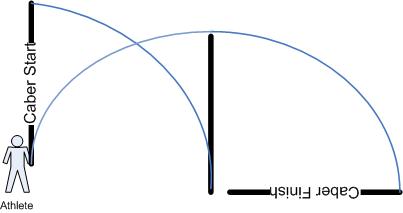
Wayne, As I consider this problem, I actually had to draw two arcs. There is the first arc created by the falling force of the skyward (bottom) of the caber. And the rising (top) of the caber. The falling arc is representative of force created by the bottom when it tips past center and falls to the ground. This would of course follow a normal gravity formula and only be modified by the height off the ground of the top held in the tosser's hands. The rising arc is created by the force applied in the pull. If I am not mistaken, the rotational force would be the result of the combined effect of the force in the falling arc beyond the center of gravity and the pulling force in the rising arc applied this side of the center of gravity. The trick being to create sufficient force into to rising arc to allow the falling arc to pull the caber over. (With a slight advantage to a taller athlete, which allows a longer falling arc) Or, I could just be talking out of my arse. ------------- Ed |
Posted By: Edward
Date Posted: 4/10/06 at 5:45am
|
Thom, I do a better job of visualizing the throw if I understand conceptually what has to happen to be successful. So, I'm not just a caber geek, I do this kind of excercise with all the events. I'm not a coach, but I bet some of the coaches on line do too. ------------- Ed |
Posted By: Wayne Hill
Date Posted: 4/11/06 at 2:28am
Your terminology is a bit, um, eccentric,  but you're hitting on one mechanism that causes rotation: if
the CG of the caber is in front of your hands (caber leaning away from
you), then there's a component of your pull that accelerates the
rotation of the caber. My analysis so far has ignored this effect, because you can obtain
rotation from the forward speed of the caber's CG when you start your
pull. However, that has the effect of linking the rotational
speed to the forward speed, which isn't such a great idea:
forward speed represents kinetic energy that can help kick the caber
over if it's close to turning, while the rotational speed mostly
determines the geometry of where the caber butt hits the ground (which
is still a very important issue). I suspect that, to do this right, you need to consider a range of:
The real problem is convincing yourself that the analysis is right: I did some preliminary runs that looked for all the world like a good caber toss, only to discover that the scaling was totally off and numerically crazy. That's why I'm talking about doing it, rather than talking about my terrific results. -Wayne ------------- "We may be small, but we're slow." - MIT Rugby |
Posted By: Silverback
Date Posted: 4/11/06 at 3:47am
|
Run? I don't get that. The caber is there, the judge is there, the crowd is there, and the guy runs off with the stick. Should be a foul. |
Posted By: Mike Wills
Date Posted: 4/11/06 at 4:24am
|
My style of caber eliminates some of the complication. Pick it, hop into position, and pull it real hard. It's easier on judges and makes the formula easier....I say we put it to a vote....eliminate the run. Anyone who refuses to do so will henceforth be called "runners"...a name that will be as detested as "spinners"!!!
------------- |
Posted By: Edward
Date Posted: 4/11/06 at 5:39am
|
My terminology is, umm, eccentric because I am not an engineer to state the obvious. I'm a finance guy. Here's the picture I sketched, then put in visio.
So you can see the two arcs I describe. My thought process being that your really not throwing 80 to 100 lbs. over the full course of the arc. Your really just moving the minimal amount of weight a given distance to allow the naturally occuring forces to take over. I think this is true in any of the scenarios. Run up, no run up, etc... ------------- Ed |
Posted By: wallyworld
Date Posted: 5/06/06 at 9:39pm
|
ALRIGHT CLASS! TIME'S UP! Everyone, lay down your pencils and pass your papers up to the front of the row! So, I'm standing here next to this pile of about 15 cabers and still don't have a better way to rate them except the old "Bradshaw" formula. And I was so counting on you guys!!! I feel let down and betrayed! ------------- "TRY NOT. DO OR DO NOT. THERE IS NO 'TRY'." Yoda |
Posted By: Wayne Hill
Date Posted: 5/07/06 at 3:04am
|
Hey, I'm still mulling! Thus, you may be let down, but not betrayed. I hope this helps. -Wayne ------------- "We may be small, but we're slow." - MIT Rugby |
Posted By: kiltedrussian66
Date Posted: 5/07/06 at 7:09am
|
Equations give Mongo headache...Mongo grab caber,Mongo turn caber Mongo happy...Mongo no turn caber Mongo sad...!!! ------------- "Never walk away from home ahead of your axe and sword.You can't feel a battle in your bones or foresee a fight."-Viking saying |
Posted By: wallyworld
Date Posted: 5/07/06 at 10:47am
Yeah! I'm feeling better already. Actually, I know for a fact that a better formula would be a great help for those A.D.s who care about their competitions. ------------- "TRY NOT. DO OR DO NOT. THERE IS NO 'TRY'." Yoda |
Posted By: Tim
Date Posted: 5/08/06 at 4:24pm
|
I've always wanted to know which variable of turning a caber is the easiest to manipulate- force of the pull, horizontal speed, angle of pull, etc. Much of that has been mentioned here. But they are all difficult to measure and don't actually apply to how one caber may be more difficult to turn than another. So we can only really just work with the known measureable physical characteristics of the caber which are length, weight, center of gravity (ratio of length), ratio of widths of both ends (may not factor much into it), and density of the wood (difficult to measure and probably irrelavant). The Bradshaw scale uses only these that are measureable. There is still something lacking to it in that I believe that longer cabers are more difficult to turn than shorter heavier ones. Gravity works on the longer cabers for a greater period of time as it is traveling through the arc than shorter ones, thus increasing the force needed to send it through the arc (or so I believe). So somewhere in the formula we need to account for the length. So if the Bradshaw scale is: Length * Weight* Taper (A/B) * 0.55 (I assume this is just a factor to bring the value to usable terms), how can we weight the length to be of more value? My idea is that we multiply again by the length of the caber, or, square the length. Thus (I like using the word "thus") the formula would be: L^2 * W* Taper * 0.55 /100 So using an earlier example, with a caber 20 ft, 110 lbs, and a taper of .667: 20*20*110*0.667*0.55 = 16141 (divide by 100 to make more usable)= 161.4 A caber of 14 ft, 160 lbs and the same taper of 0.667 would be: 14*14*160*0.667*0.55 /100 = 115.0 So even though the second caber is almost 50% heavier than the first one, it rates lower on the scale because it doesn't have to travel as far through an arc to reach 90 degrees. Wayne, you might to run this through some scenarios to see if it checks out. The formula may need some tweeking, but for me it seems to make sense at first glance. Who knew that turning a caber could be so geeky?     Good luck and continue with the debate, this is interesting. ------------- "Remember, you don't take respect, you can only give it." Myles Wetzel-Forum post 10/2/07 Rock the House |
Posted By: Wayne Hill
Date Posted: 5/09/06 at 1:53am
|
Yeah, I hear you. I will continue mulling. -Wayne ------------- "We may be small, but we're slow." - MIT Rugby |
Posted By: Jeff Ingram
Date Posted: 6/06/06 at 4:54am
| Math makes me sleepy. |
Posted By: HammerGunn
Date Posted: 6/06/06 at 7:12am
|
This is way too complicated to be associated with highland games... ------------- North Dakota supports global warming. |
Posted By: kspell
Date Posted: 6/06/06 at 8:30am
|
Sam: You should come to Wyoming, just drive West; young man! ------------- Cheers! Kirk |
Posted By: wallyworld
Date Posted: 6/30/06 at 10:51am
|
Tick tock tick tock tick tock tock tock tick tock tick tock tick tock tick tock ------------- "TRY NOT. DO OR DO NOT. THERE IS NO 'TRY'." Yoda |
Posted By: wallyworld
Date Posted: 12/18/06 at 12:38pm
|
Just when you thought it was safe to go out to the caber pile........ During a recent conversation, it was brought up that the tweaking of the "Bradshaw" formula was never completed. It seems like Charlie Black spent less time getting his Doctorate! Since the conversation was with another AD, there's at least two of us out here needing a better way to rate cabers. ------------- "TRY NOT. DO OR DO NOT. THERE IS NO 'TRY'." Yoda |
Posted By: Wayne Hill
Date Posted: 12/18/06 at 2:50pm
|
There are several of us involved in attempting to model caber tossing,
but it's actually quite difficult (there's a lot of itchy boundary
conditions). People who really want to help should do the following:
------------- "We may be small, but we're slow." - MIT Rugby |
Posted By: Silverback
Date Posted: 12/19/06 at 2:48am
|
I think you can rate the cabers but not the tosser. Each person might have different abilities with different types of sticks depending on speed and power of each person. And each tosser has many variables with injury, time of season, lunch quality and so forth. There is also no place on the chart for amonia and emotional unload. The caber is right after the hammer. Some people might be very emotionaly upset after the hammer and have a tremendous unload on the dead wood. Some people are just waking from their nap at lunch. |
Posted By: Hapy
Date Posted: 12/19/06 at 7:35am
|
Myles kicks ass ------------- Real Men Wear Purple Tinky Winky Throw Far! http://www.facebook.com/CVTSA" rel="nofollow - Central Vermont Strength Association |
Posted By: wallyworld
Date Posted: 12/19/06 at 7:44pm
I'm afraid that here's what's gonna' happen. We'll end up with a formula that's so complex that very few A.D.s will bother with it OR absolutely nothing changes! I think that McSanta was onto something at the beginning of this thread!
Don't forget what the original goal was. A simple tool to use to determine the difficulty of turning one caber as opposed to another caber. Not what it takes to launch it into orbit. Maybe the multiplier should not be "2," it could be as low as 1.01 or an amount higher than 2. Just start with a reasonable number. This is certainly not without precedence! RMSA has tinkered with the formula since its conception. They've changed the multiplier and the scoring points in an attempt to make it more workable. Remember what Einstein said, "Keep it simple, but not too simple!" ------------- "TRY NOT. DO OR DO NOT. THERE IS NO 'TRY'." Yoda |
Posted By: McSanta
Date Posted: 12/21/06 at 10:10am
|
There seems to be agreement that the Bradshaw formula captures the elements that should be used to rate/rank a caber. We also seem to agree that the formula does not give enough weight to those with longer cabers or to much weight with those with shorter cabers, so I suggested in the earlier post a simple way to adjust the Bradshaw formula. As it was pointed out, the parameter or factor I used is probably not correct (since I pulled it out of the air). As a trained statistician, I would love to have data to fit a model to. The problem is what data should I be using?
I will take Waynes idea one step further:
Either do this retroactively from last year's score sheets or make an effort to do it in the up coming season. At the end of the season, use this information to rank the cabers from easiest to hardest to turn in each class by a measure = successes divided by attempts. From this point, we modify the Bradshaw formula in a manner that produces a score that with luck will closely reflect the rankings.
------------- Mark McVey "The work of science is to substitute facts for appearances and demonstrations for impressions." -John Ruskin |